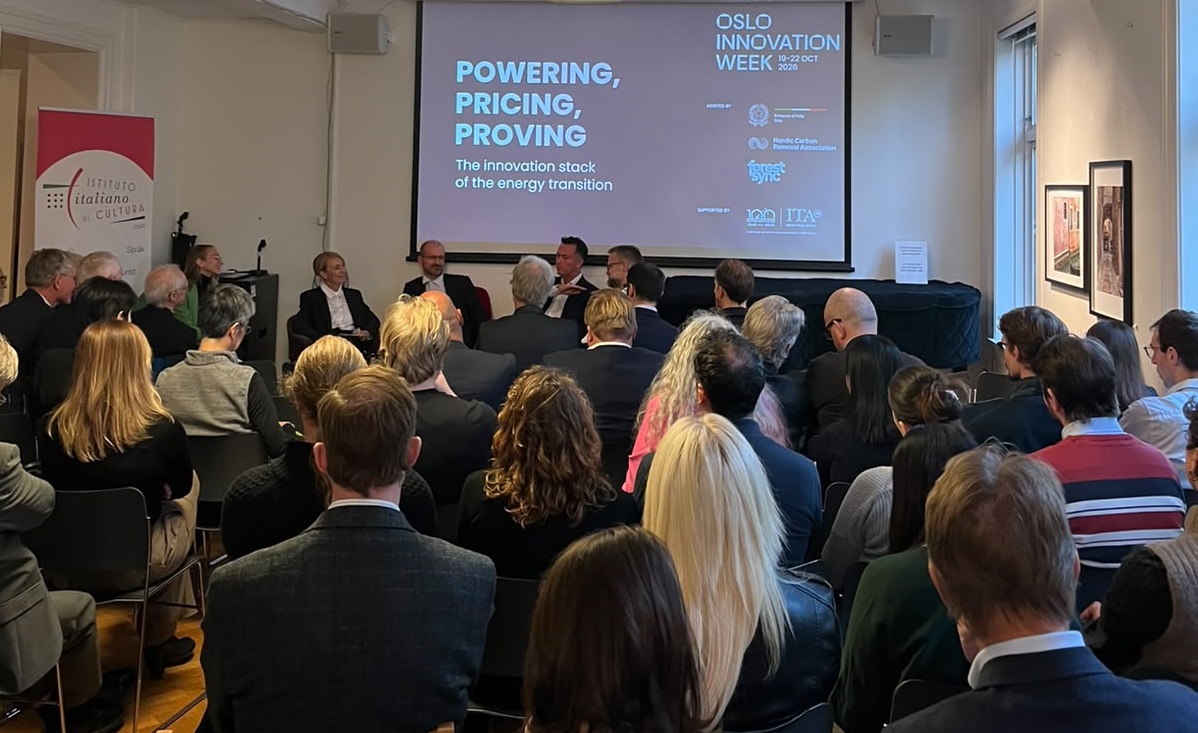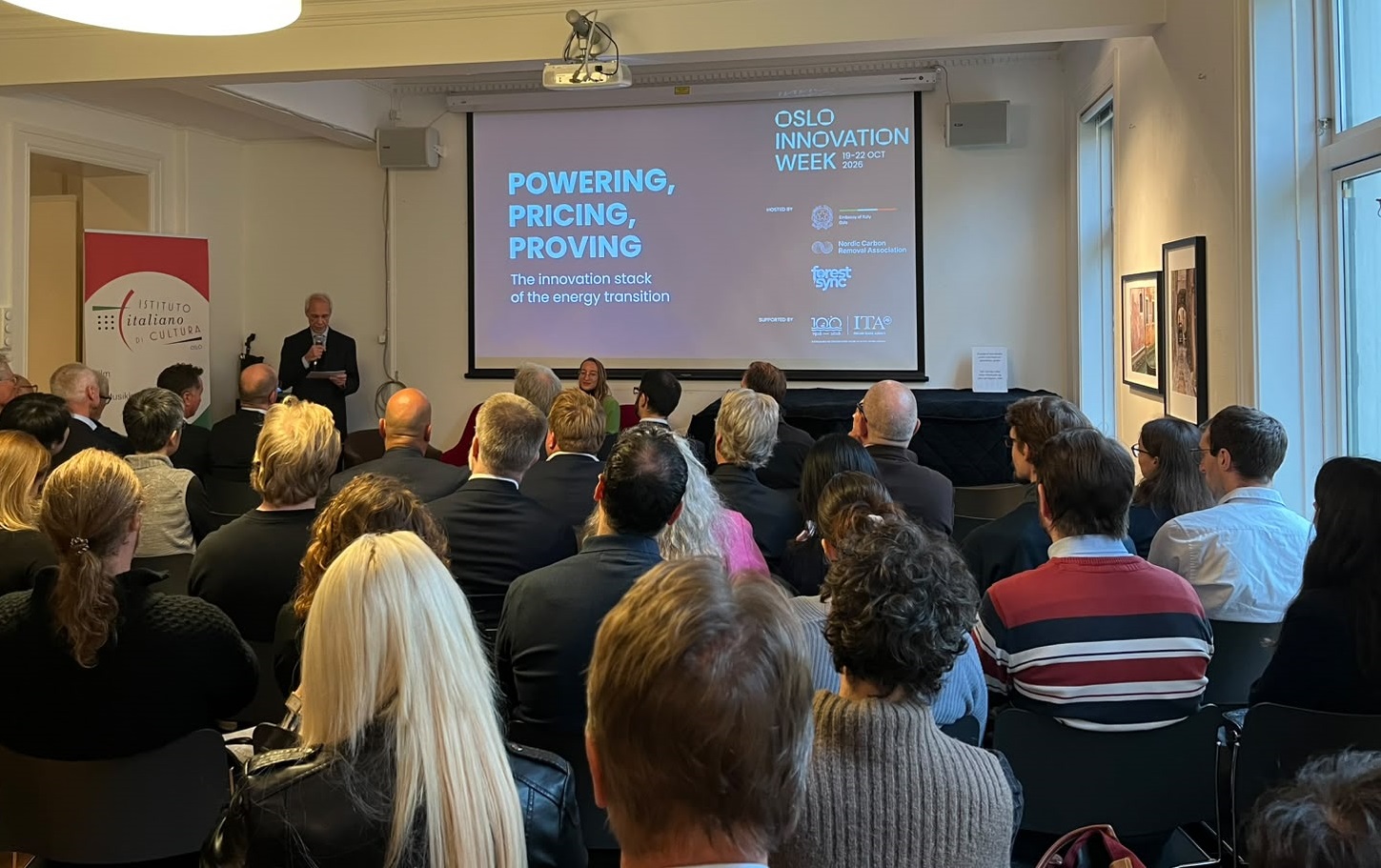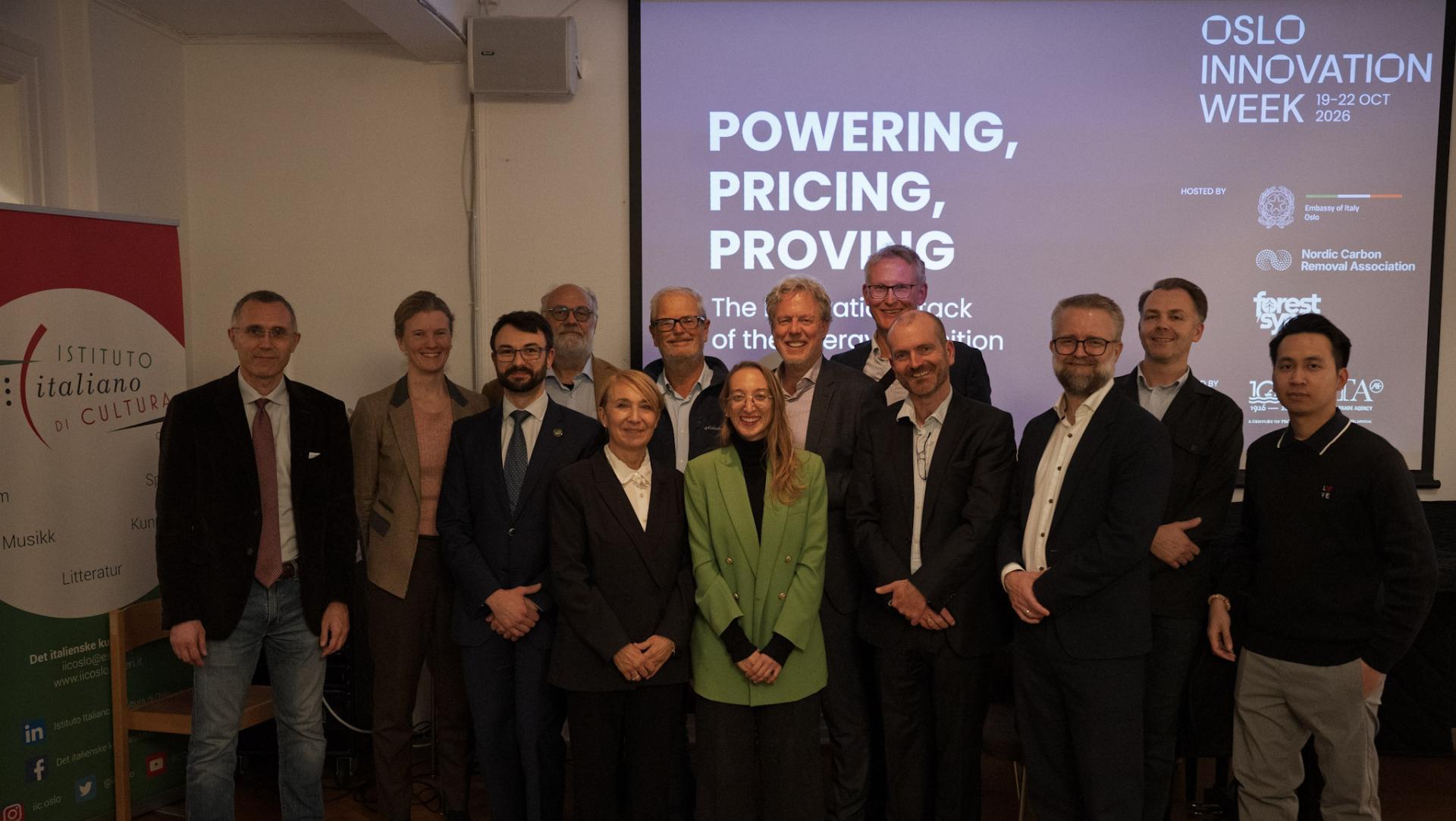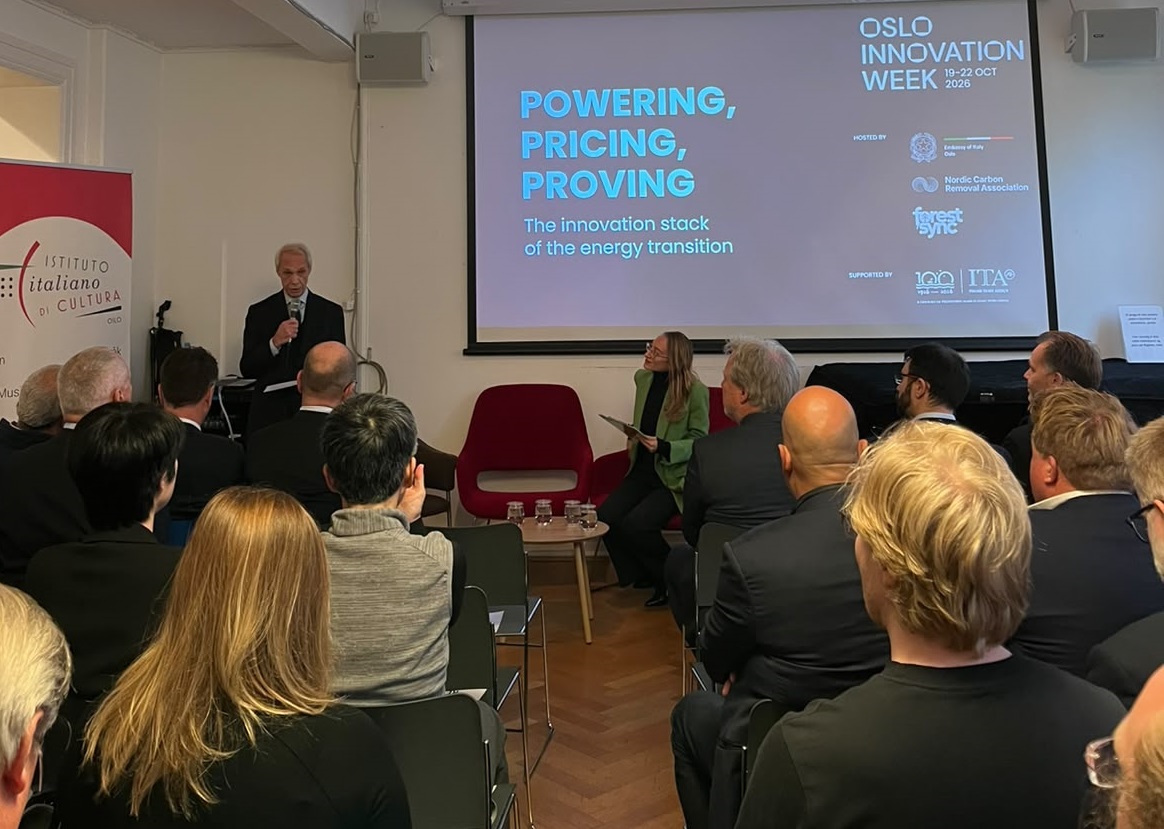
On October 21, the Italian Cultural Institute in Oslo hosted the seminar “Powering, Pricing, Proving: The Innovation Stack of the Energy Transition”. The event was part of the official program for Oslo Innovation Week, an international event featuring over 80 initiatives, including conferences, seminars, workshops, and other events, where incubators, scientific institutions, investors, companies, and startups showcase innovative solutions aimed at achieving the Sustainable Development Goals.
Organized through a collaboration between the Embassy of Italy in Oslo, the Nordic Carbon Removal Association, and the startup ForestSync, the seminar brought together a select group of experts and professionals from the energy and environmental sectors. They examined the current state of the energy transition, focusing on three key components: clean energy production; the creation of market infrastructure to assign economic value to CO₂ removal; and systems for analyzing the outcomes of emissions-reduction efforts using reliable methodologies and verifiable data.
The event, moderated by green transition and sustainability expert Giulia Marzetti, consisted of three discussion panels. The first featured Anders Ystad (Equinor Power), Christian Andresen (SINTEF Energy), Ingvald Straume (Hydrakraft), and Laura Serri (RSE – Ricerca sul Sistema Energetico), who discussed the status and future prospects of offshore wind and marine energy from both Northern European and Mediterranean perspectives. The second panel—featuring Sean Cappone (ForestSync / Carbonomex), Per Richard Olsen (Removr), Kenneth Juul (Carbon Centric), and June Snemyr (law firm Advokatfirmaet Thommessen)—explored the role of procurement mechanisms, price transparency, and regulatory frameworks in fostering investment in CO₂ removal technologies and capacity. In the third and final panel, Timothy Lucie-Smith of the Fondazione Sorella Natura and Professor Riccardo Valentini—a leading expert in the ecology and management of agro-forestry systems, and a former member of the Intergovernmental Panel on Climate Change (IPCC) working group that was awarded the Nobel Peace Prize in 2007—examined how to measure and demonstrate the impacts of climate change, and how to translate scientific evidence into concrete policies and collective awareness.
The Italian Ambassador to Norway, Andrea Cavallari, who opened the event, highlighted “the importance and relevance of the topics promoted and discussed during the seminar, before a highly qualified and diverse audience of professionals and experts in the fields of the environment and the green transition. With COP31 in Antalya just a few weeks away, we sought to stimulate reflection on how to make the energy transition not only technologically feasible but also economically sustainable and scientifically verifiable. This served not only as an important opportunity for in-depth technical analysis, but also as a moment to foster relationships, share expertise, and develop collaborations between the Italian and Norwegian energy and innovation sectors.”